Fact finding mission, Burkina Faso, september 2009
The Network Institute from VU and the VU Centre for International Cooperation embarked on a mission to initiate a link between farming in Africa and information and communication technologies. This has resulted in a project of higher education in Informatics, focussed on Web Technology with a component of outreach and social responsibility. The proposed name of the project is "Web Alliance for Regreening in Africa".
VU’s rural development expert Chris Reij has worked in the Sahel since the late 1970s. Chris Reij’s work is aimed at improving conditions of subsistence farmers who live and work in rural areas with harsh climate conditions and poor soils.
In the 1980s several periods of drought severely deteriorated living conditions in many of the rural communities in the Sahel. However, through perseverance a number of innovative farmers in Burkina Faso, Niger and Mali, using simple but effective techniques, succeeded in rehabilitating a large area of degraded land. Now, 25 years later, an area of 5 million hectares has been restored and converted in fertile fields with crops and trees through the arduous work of these farmers. Sahel in these areas has literally been regreened. There are more trees now, more crops, and living conditions have been spectacularly improved for the local communities. Not only from a socio-economic but also from an environmental point of view this is an important achievement.
The Sahel Regreening Initiative (SRI) is a grassroots initiative to enhance communication and dissemination of information amongst farmers. Some agro-forestry experts from Niger, Mali and Burkina Faso are also involved in the initiative. SRI’s objective is to disseminate knowledge about regreening techniques from one farmer community to another, from one region to another, and even from one African country to another. This communication and spread of knowledge helps farmers to better fight land degradation to improve crops and preserve trees. Chris Reij coordinates and animates the initiatives.
Another project is now being linked to the existing Sahel Regreening Initiative, a similar project named SCI-SLM (Stimulating Community Initiatives - Sustainable Land Manage) involving farmers from four African countries: South-Africa, Ghana, Uganda and Morocco, with a similar objective to disseminate knowledge amongst farmers. This project is also coordinated by VU/CIS, (co-funded by the Global Environment Facility) and has just started this month. Since the objectives and the conditions are similar, it is good to link both projects to each other.
Apart from regreening initiatives, another great development is taking place in Africa since the last decade: the almost overwhelming growth of mobile telephony into all levels of society. Almost 40 % of the population in the whole of Africa owned a mobile phone in March 2009, and the figure is rising, as we are talking. Millions of new subscribers are joining the mobile telephony network every month, in Africa. The lowering of prices and the prepaid paying systems have made mobile phones affordable, even for the very poor.
The farmers of the SRI initiative are amongst the groups that benefit from the availability of mobile telephones. These recent developments are boosting dissemination of indigenous and rural knowledge. Opportunities now exist for SRI, to be supported in the near future by new, innovative information and communication technologies.
Activities during the mission
A four day excursion was organized as a fact finding mission, to meet each other and to synchronize ideas and make future plans.
Saturday September 26, 2009 – Arrival of Hans Akkermans and Anna Bon in Ouagadougou, capital of Burkina Faso. Meeting with Chris Reij, Wendelien Tuyp and Saah Dittoh, professor from the University of Development Studies in Tamale, Ghana, and Ghanaian coordinator for the SCI-SLM project.
Sunday September 27, 2009 – Meeting with Mathieu Ouedraogo and Adama Belemviré, both Burkinabés, agro-forest specialists, and both involved in SRI since many years. Mr. Ouedrago is invited to be one of the key-note speakers at the VU Dies Natalis Symposium on October 20th.
Departure to a village named Gourcy and a larger city named Ouahigouya at 7.30. It is a 140 km drive north, on a very good asphalt road.
The first excursion stop is a visit to a rural community named Ranawa. It has about 2300 inhabitants, and is located a few kilometres east of Gourcy. This village is an example of a rural community that has actively been regreened the past two decades and that widely benefited from its own proper and innovative land management. We visit the fields and watch the growing crops of sorghum, millet, maize, sesame, okra, egg plant, tomato etc. and the large number of trees that have grown, and now offer shade and benefit to the crops, livestock and to the farmers.
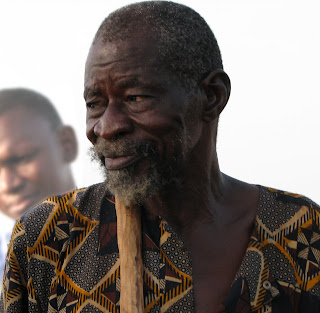
After the walk on the field we all gather in the shade of a large tree, and discuss the actual situation with the farmers, a group of about twelve inhabitants of Ranawa. The village chief, is an elderly person of probably over 80 years is; a younger person acts as his spokes person. Translations are made almost simultaneously, from, the local language Moré into French, and English and vice-versa. Ten women join our group, but separately in an adjacent circle, next to ours. The younger people here speak French, the elderly ones only communicate in their local language. Despite the language gap, communication goes very well; the farmers are open and share their experiences with us, and are willing to answer all of our questions.

In this village up to 98 % of the households use mobile phones. Phones are not only used for social communication but also for business, to check market prices in town, to negotiate with potential customers about prices of commodities and crops, etc. People seem to spend about 1000 up to 5000 francs CFA (2 -10 euros) per month on mobile telephony. Some people in the village earn money selling airtime (telephone units) in very small units. Even charging the phones through mobilette batteries represents a business opportunity here, since the electricity net has not yet reached this village. Useful options such as remote charging of airtime and possibilities for airtime transfer are services offered by the telecom providers, and offered as a service named SAP-SAP. These activities generate income for local people reselling these mobile services.

The community as a whole is aware of the importance of mobile telephony for improvement of their livelihoods. The farmers and their families are open to innovation and new systems of communication.
After lunch in the Crocodile Bar in Ouahigouya by our group, a visit is made to the field of another innovative farmer: Ousseni Kindo, near a village named Bogaya. Ousseni Kindo is one of the farmers who restored degraded land and protected trees on his fields. We witness the successful outcomes of twenty years of hard labour and innovation.
Afterwards another farmer-innovator is visited: 70 year old, famous Yacouba Sawadogo. This man regained an area of more than 100 hectares of degraded land and turned it into a green forest. This is the vastest area of restored biodiversity in Burkina Faso, probably even in the Sahel. This is an example of good sustainable land management.

From left to right: Mathieu Ouedraogo, Yacouba Sawadogo, Chris Reij, Hans Akkermans
Yacouba Sawadogo has already received international acknowledgement for his achievements. Mr. Sawadogo who only speaks Moré, will be VU’s special guest on October 20th, at the Dies Symposium World Wide Web for Social Development. A few days after the Dies Symposium, Mr. Sawadogo will proceed to a conference named “Greening the Sahel”, which is organized by Oxfam America and IFPRI (International Food Policy Research Institute) in Washington, US, together with Chris Reij and Mathieu Ouedraogo. Mr. Sawadogo will be a special guest at the White House during this visit.

Yacouba Sawadogo working on the field
Late in the afternoon a visit is made to a local radio station, La voix du paysan, the voice of the farmer. Radio is a highly effective medium of communication in rural areas in Africa. Almost all households own a radio and the coverage is high. This radio station reaches about one million people every day. Radio might play an important role for communication within the W4RA project. Radio broadcasting could possibly be used in combination with podcasting, and other web enabled systems. The owners of the radio station are open to innovation and willing to collaborate with us in this initiative.
Spontaneously, an interview is held with Chris, about the history of SRI and the W4RA. This clear, enthusiastic and lively account of the current initiative is broadcasted live, while we all listen to the car radio, standing outside the studio in the falling evening light.
Sunday September 27, 2009 - Visit to the mayor of Ouahigouya.
Issues are discussed regarding the ownership of lands and threats to Yacouba Sawadogo’s forest due to regional politics. The mayor expresses his personal support for our initiative.
Visits are made to a few telecentres in the neighbourhood of Ouahigouya and Gourcy. Some of the internet cafés have a 128 kbps connection to the internet and charge about 200 f CFA per hour usage(about 0,30 EUR). Other telecentres lack internet connection and offer only applications and printing as a service.

Return to Ouagadougou by all mission participants
In the capital a visit is made by our mission participants to the Burkina Faso headquarters of mobile provider Zain, former Celtel and now Kuwaiti owned pan-African mobile telephony company, with presence in 19 African countries. We meet sales manager Mr.Carlos Yanogo and Ms Alice Gisèle Coulidiati, sales adviser. We ask them whether Zain would be open for collaboration or even sponsorship in an initiative such as SRI and W4RA, when it comes to mobile-web integration etc. in the benefit of the farmers in the Sahel. Mr Yanogo expresses his interest and tells about the corporate responsibility of Zain, in which policy some activities might be positioned. Obviously the executive officers of this company will still have to approve our plans. However, Mr Yanogo gives us the impression that opportunities of collaboration with Zain may occur in the near future of our project.

Zain marketing campaigns in Ouagadougou
The last evening we have a brainstorming session at Hotel Ricardo’s, in Ouagadougou, where we are staying, all mission participants: Hans, Chris, Mathieu, Adama, Saah, Wendelien and myself (Anna). We discuss the possibilities of introducing the Web Science, Web-based technology, Web-mobile integration, training to local staff in information and communication technologies and many more possibilities, which will be in the benefit of the regreening initiative and farmers in Burkina Faso, the Sahel, and possibly the whole of Africa. The Network Institute will imbed these activities within the faculty’s research and education, to ensure sustainability of the project within the VU. Research and education in mobile-web technologies will become part of MSc. and a new minor in Web Science at the department of Informatics of VU. A PhD research by a Ghanaian candidate, funded by a Nuffic project will be part of the project.

From left to right: Hans Akkermans, Saah Dittoh, Mathieu Ouedraogo, Chris Reij, Adama Belemviré, Wendelien Tuyp. Only Anna Bon (the photographer) is missing on the picture.
A huge information revolution is taking place at an unimaginable pace in Africa. Now is the moment for action. We should therefore start small but not forget to think big.
Participants:
Hans Akkermans (VU Network Institute)
Chris Reij (CIS/VU)
Wendelien Tuyp (CIS/VU)
Anna Bon (CIS/VU)
Mathieu Ouedraogo (Réseau MARP)
Adama Belemviré (Réseau MARP)
Saah Dittoh (University of Developement Studies Ghana)
Report by Anna Bon, Burkina Faso, September 2009


